

“The things I learned during the course are really practical. I can easily use it in my daily work.”
The second day we started with sample preparation. After  Jorge’s talk about general considerations, we “selected” volunteers prepared samples of blood, epithelial cells, nanoparticles and hair. It is always interesting to see how reluctant some students are to prick their fingers with a needle! The day continued with talks on AFM operation, data processing, and artifacts. Finally, we had a fantastic talk from Rui Rocha, who introduced us to some applications from materials science, and showed some few interesting AFM techniques and tricks as well.
“I like [the course’s] composition (theory lectures/ application lectures/practical lessons). Moreover, there were people with different focus of their work, which could be inspiring in what I could do in our lab.! Since our AFM is very automatized, I discovered the basics which are just essential for the work. Moreover, I was surprised in how many modes could AFM work. We'll definitely try to exploit our AFM in new applications”


In the evening we had our course meal, for which we visited Taylor’s Port wine lodge, to find out all about Port production, and soak up the amazing atmosphere in the cellar, followed by drinks on the terrace, with the sun just going down, and a really nice meal of Portuguese food. As usual Taylors were great hosts, and everyone seemed to enjoy this. The Port wine bottle certainly made a few trips around the table!

“The night out in Taylor was extraordinary: the view of Porto from the balcony, the wine and the food, and the stimulating conversations. Where in the world can you find such a perfect combination?”
 On the last morning, we had our data-analysis class, and everyone learned all about the different methods for processing, and analysis of AFM data. This is one of the most popular parts of the course, and I think the students who are already producing their own AFM data find it genuinely useful. Finally, Dr. Filomena Carvalho came from Lisbon to give us a talk all about some of the more exotic experiments that can be carried out using AFM, including mechanical and force spectroscopy measurements on living cells.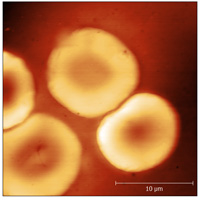
“Thank you for the course, its good organization and great hospitality!”
Finally, congratulations to María Virumbrales Muñoz from Zaragoza University, on winning the imaging and processing competition, with the nice image of erythrocytes on the right (sample kindly donated by Hannie!). Maria, your prize is on it's way!
Course tutors: Dr. Peter Eaton, Dr. Jorge Caldeira
The course is scheduled to run again during Easter 2015. If you are interested in being informed when registration is available, email: This email address is being protected from spambots. You need JavaScript enabled to view it., or use the contact page.